The Peninsula has a category of wedding venue that most couples never find in a search: private garden estates in Woodside, Portola Valley, Atherton, and Los Altos Hills, rented out for weddings a handful of weekends a year by owners who want to defray the maintenance cost of a property they can barely justify keeping otherwise. These weddings rarely show up on Instagram because the owners require it. This is a seasonal guide to booking one, and why the neighbors matter more than you think.
How the private estate rental market actually works
A private Peninsula estate does not have a wedding venue website. The property is booked through a specialty broker (a handful of Bay Area wedding planners quietly represent estate portfolios), through word of mouth in local wedding-vendor networks, or through a discreet listing on a private-events platform. Site fees run $12,000 to $40,000 for a Saturday, higher for estates on 5+ acres.
The estates are not full-service. You bring the caterer, the florist, the planner, the tents, the tables, the chairs, the bar setup, and often the toilet trailer. What you get is the property: the garden, the pool (usually) as a design feature, the lawn, and the ceremony spot. The rest is a professional rentals project.
Spring (March through May): the garden is at its peak
Peninsula garden estates are at their most beautiful in April and May. Roses in bloom, wisteria at Filoli-style trellises, azaleas at peak color. May is the single most-booked month for these venues, with dates locked 12 to 18 months out. Weather is reliable: 65 to 75 degrees at ceremony hour, low humidity, and clear skies most Saturdays.
The spring tradeoff is pollen. Guests with severe seasonal allergies will suffer at some Peninsula estates in April; the pollen count in Woodside can hit 10 out of 10 during peak weeks. Warn guests in advance in the invitation website, and stock antihistamines at the bridal suite.
Summer (June through August): warm afternoons, safe weather
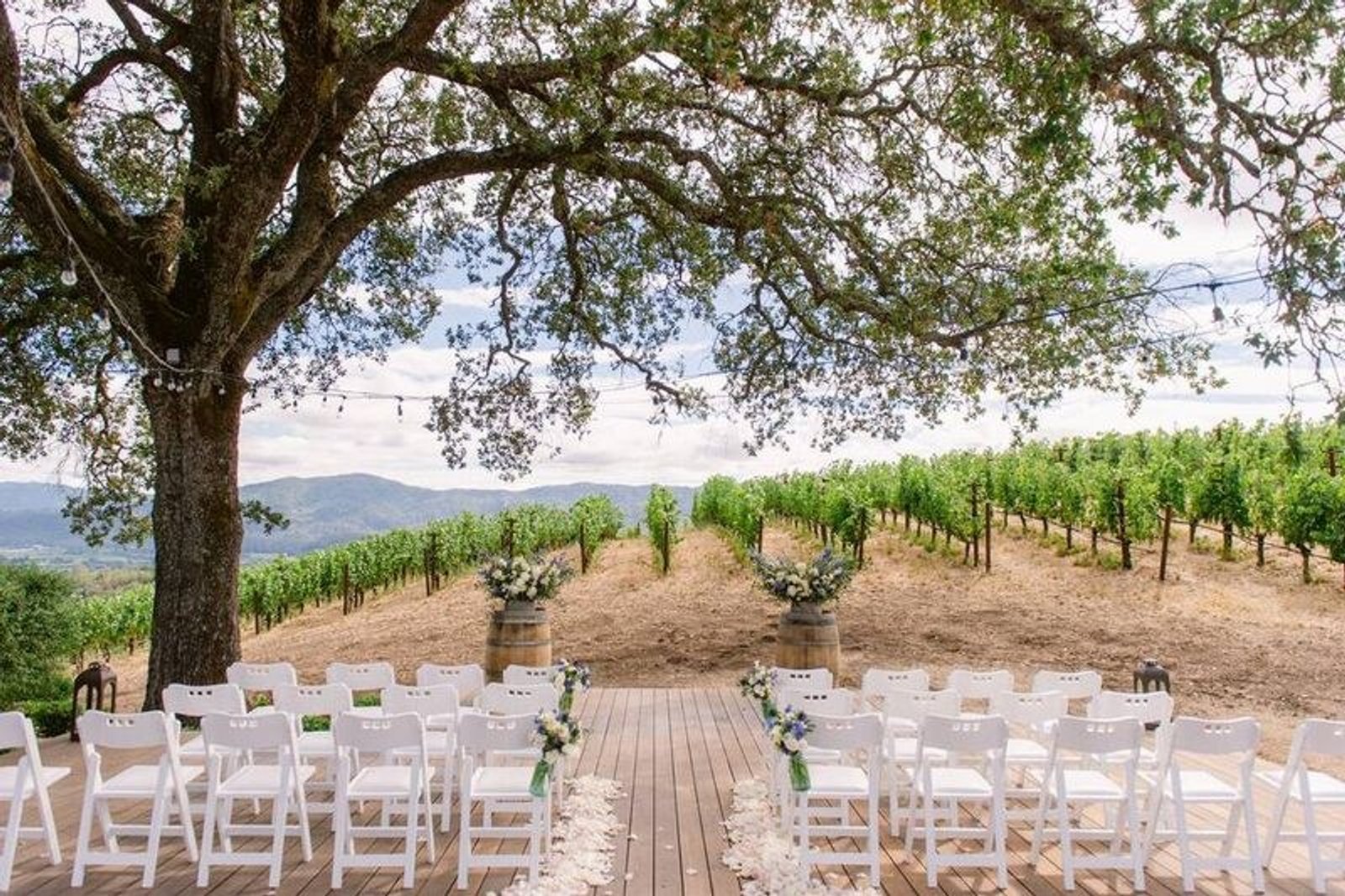
Summer at Peninsula estates is warm but rarely uncomfortable. Ceremonies at 4 p.m. run 75 to 85 degrees; by 7 p.m. dinner is 68 to 74 degrees. The estates that flatter summer weddings are those with mature shade trees over the ceremony spot; check for oak, redwood, or cedar canopy in your specific venue's ceremony area.
The summer catch is fire risk. Peninsula estates on the western slopes (Woodside, Portola Valley) fall inside CalFire's very high fire severity zones from July through October. Some estates prohibit open flames during red-flag warnings, which can eliminate candles, sparklers, and outdoor propane heaters. Ask the estate manager about their specific fire-restriction protocol.
Weather questions to ask before booking
- What is the ceremony spot's shade coverage at your chosen hour?
- Is there a wet-weather backup that seats your full guest count?
- What is the estate's policy during red-flag fire warnings?
- Are propane heaters allowed year-round for evening cold?
Fall (September through November): the sweet spot
September and October are the second peak (after May) at Peninsula estates. The gardens are still lush but past their pollen-heavy spring, the weather is warm without being hot, and the light at 5 p.m. is soft and golden. Fall foliage on the Peninsula is subtle (this is not New England) but a few estates have deciduous trees that hit color in mid-October.
November brings shorter days and the first fall rains. By late November, expect real weather variability; a wet-weather backup is essential. The tradeoff is pricing, which drops 15 to 25 percent from October peak.
Winter (December through February): rare bookings
Peninsula estates rarely book winter weddings. The gardens are less compelling, the days are short, and the estates' outdoor infrastructure (bar, ceremony chairs, dance floor tent) requires heating that adds significant cost. Some estates close entirely for December through February. Those that stay open offer 30 to 50 percent discounts, which can make sense for couples who want a small, intimate wedding under 60 guests inside a heated indoor space.
The neighbor problem
Peninsula estate weddings live or die on the neighbors. Every private estate rental operates under a residential-use permit that limits event frequency, amplified music hours, and guest count. Neighbors call the sheriff for complaints, and repeated complaints revoke permits. Estate owners who lose their permit lose the entire wedding-rental business.
This is why estate owners are picky about the weddings they book. They want couples who understand the noise cutoff (typically 10 p.m. for amplified music), who will use valet parking (never street parking), who will keep the guest count within the permitted limit (usually 120 to 175), and who will not send drone footage that ends up on a public Instagram. Cooperate with all of this and the wedding is exceptional; push against any of it and the estate quietly declines to book you.
The rental-fee-plus-vendors math
For a 140-guest Peninsula estate wedding in September, budget: site fee $18,000 to $28,000, tenting and rentals $22,000 to $38,000 (this line is high because you are building the entire event infrastructure), caterer $18,000 to $32,000, bar $6,000 to $12,000, florals $12,000 to $22,000, photo and video $10,000 to $20,000, DJ or band $4,000 to $12,000, planner (essential here) $8,000 to $18,000. Total: $110,000 to $180,000. These weddings are expensive because you are essentially building a temporary venue on private land.
Why it might still be worth it
A well-executed Peninsula estate wedding delivers something no venue can: complete privacy, no shared calendar with another wedding, and an aesthetic that is specific to the property rather than to a wedding-industry template. Guests who attend one of these weddings remember it in detail years later. Whether it is worth the cost depends on your budget and how much you value that specific quality. For couples who can afford it and value privacy above almost any other factor, the Peninsula estate is unmatched in the Bay Area.
Browse Vendors