If you’re planning a Bay Area wedding ceremony in 2026, the music question usually shows up right after you pick a venue: do you hire live musicians (a guitarist, harpist, or strings) or do you press play on a perfectly-curated playlist? The right answer depends less on what looks “luxury” on Instagram and more on what your venue can support, what your guests will actually hear, and how much you want to manage on the day.
Below is a practical, Bay Area–specific framework for deciding between live instruments and recorded tracks (plus a hybrid option that’s become very popular). Every venue’s program changes — confirm current policies and sound requirements with your venue’s events team.
What guests actually notice during a ceremony
Most guests don’t remember the exact song you chose for your processional. They remember whether they could hear it, whether the volume felt appropriate, and whether the transitions were smooth (no awkward silence between “processional” and “officiant mic check”).
Live musicians can elevate the moment, but a flawless recorded setup often beats “live, but hard to hear” — especially outdoors or in a windy coastal spot.
Live vs. recorded: a quick comparison
- Live instruments feel organic and can “fill the space” even at low volume.
- Recorded tracks give you exact versions of songs (original vocals, specific edits) and predictable timing.
- Live typically requires more logistics (arrival, setup space, shade, power, and sometimes amplification).
- Recorded still needs a real sound plan: speaker placement, mic(s) for the officiant, and someone responsible for pressing play on cues.
What it costs in the Bay Area (2026 reality check)
Pricing moves fast, but here are ranges we’re seeing published in 2026:
- Full wedding DJ coverage in the Bay Area commonly ranges from about $750 on the very low end to $5,000+ for a full-day, production-heavy package (ceremony + reception + lighting/live add-ons).
- Some DJ/live-music studios publish Bay Area packages roughly in the $2,800–$7,000 range, with a commonly-booked tier around $3,500–$5,500 including ceremony sound support.
- For ceremony-only live music, many soloists and small ensembles start around the mid-hundreds (often $450+ for entry-level listings), then scale up with travel, extra sets (cocktail hour), and custom arrangements.
The biggest budgeting mistake is comparing “musician fee” to “playlist = free.” In practice, the real comparison is live musician(s) vs. recorded music plus a reliable sound system and microphones — and a person who owns the cues.
The Bay Area sound checklist (don’t skip this)
1) Who is providing the ceremony sound?
Ask this early. Some venues have in-house sound; others require your DJ; some couples use a dedicated ceremony-sound vendor. If you’re using a musician only, that musician may not provide microphones for vows/officiant.
2) Power, shade, and wind
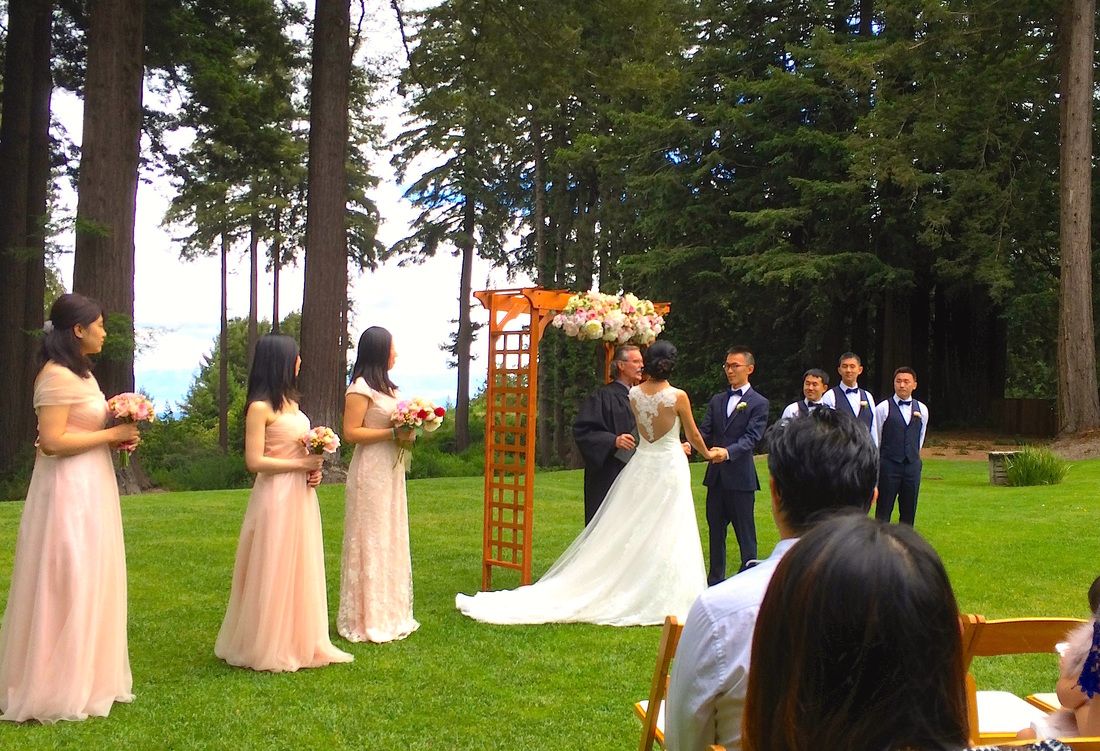
Outdoor ceremonies in places like the Headlands, coastal venues, or open wine country lawns can be windy. Wind impacts both instruments and microphones. Confirm power access and whether battery-powered amplification is needed.
3) Your cue sheet (processional timing matters)
Whether live or recorded, write down exactly what plays when: seating, wedding party processional, partner A entrance, partner B entrance, any ceremony interludes, and recessional. Give it to your coordinator/officiant and whoever is running sound.
When live instruments are worth it
- Your ceremony space is intimate and controlled (indoors, sheltered courtyard, or redwoods with a clear sound plan).
- You care more about “vibe” than a specific recording (live strings can make even simple melodies feel cinematic).
- You want flexibility: musicians can extend a processional if someone walks slowly, or loop a chorus if photos run long.
When recorded tracks make more sense (and still feel elevated)
- You want the original vocals or a very specific arrangement.
- Your ceremony is in a challenging outdoor spot and you’d rather put budget into dependable amplification and microphones.
- Your timeline is tight and you want fewer moving pieces (especially for a first-look heavy day).
The hybrid approach Bay Area couples love: live moment + DJ for everything else
If you want a “live” feel without the cost and coordination of multiple live sets, consider booking one live element for the ceremony (or the first 20 minutes of cocktail hour), then letting your DJ take over. Some Bay Area teams explicitly offer DJ + live fusion options (adding sax, percussion, or strings) and include ceremony sound support in mid-tier packages.
A few real Bay Area options to start your search
These are examples of real groups and vendors with Bay Area presence; availability, pricing, and staffing change season to season, so confirm current terms directly.
- Sounds Elevated (Berkeley) — DJ + live musician options, and they publish a Bay Area package range and notes about ceremony sound support.
- Sutro String Quartet — advertises weddings and private events, with availability noted for the San Jose area.
- Le Jazz Hot Trio (Hot Club of San Francisco universe) — a gypsy-jazz style trio that performs around the East Bay (example show listed in Martinez).
- If you’re on a tight timeline, vendor marketplaces can be a starting point for ceremony-only musicians, but always vet reviews, recordings, and backup plans.
Song planning: a simple timeline
- 8–12 months out: decide live vs recorded (and confirm venue sound rules).
- 3–4 months out: choose songs and key cue points; book any custom arrangement time if you’re going live.
- 2–4 weeks out: finalize the cue sheet and confirm microphones, speaker placement, and rain/wind plan.
FAQ
Can I just use a Bluetooth speaker?
For a true micro-wedding with under ~20 guests in a quiet indoor space, sometimes. For most Bay Area venues and outdoor locations, you’ll want professional amplification and at least one wireless mic so guests can hear vows and the officiant clearly.
Do live musicians need microphones?
Sometimes. A string quartet can carry in a small indoor room, but outdoors (or for larger guest counts) you may want light reinforcement. Your officiant and vows almost always need microphones.
Browse Vendors